React vs Angular: Which Is A Better JavaScript Framework?
Choosing the best JavaScript frameworks for web applications can be a time-consuming and overwhelming task. The two hot frameworks on this topic are React vs Angular. These two frameworks are descended from two formidable competitors, Google and Facebook. React is well-established in the industry, but Angular is a relative newcomer. The performance of React vs Angular is frequently debated.
Both React and Angular are open-source and free to use. React is maintained by Meta, while Angular is maintained by Google. This means both frameworks have strong long-term support and active development behind them.
Both Reactjs and Angular are open-source products, and both are used by major brands. Every time front-end programming is required, the debate between Angular and React erupts. This article will examine which framework is superior in which situations.
So, which one should you use: Angular or React? Let us see with points.
What is React?
Facebook released React in 2013. It supports JavaScript languages and can render data from both the client and the server. It enables developers to create a centralized UX and complex UI. It has a component-based architecture and uses one-way data binding technology. Its learning curve is short.
Creating highly reusable components and assisting in a modular, cohesive development process. Developers can reuse the logical portion of an app by simply switching the view. Maintenance and upgrading are simplified by self-contained components.
Important Characteristics
- It enables the use of third-party libraries.
- It is simple and configurable.
- It improves the user experience and speeds up performance.
- It saves you time.
- It supports both Android and iOS platforms.
- It provides code stability through one-way data binding.
- It promotes faster development.
- It makes it very simple for developers to migrate a React app.
What is Angular?
Angular is a component-based framework for developing scalable mobile and web applications. Angular is a one-stop shop for developing desktop and mobile applications. Google's Angular team created and maintains the open-source JavaScript front-end framework Angular. Angular is the most widely used client-side framework for creating scalable and high-performance mobile and web apps with HTML, CSS, and TypeScript. Angular 19 is the most recent version, and it provides enterprise-ready web app development solutions.
It includes a set of developer tools for creating and scaling projects ranging from single-developer to enterprise-grade applications. Angular is a typescript-based development platform that provides a unified user experience.
Advantages:
- It provides high performance.
- It has widespread community support.
- It is technologically sound.
- It provides cleaner and crisper coding.
- It provides better error-handling support.
So, What to choose?
Let us analyse and compare various factors of this platform to understand and choose the perfect JavaScript frameworks for your next term project.
Learning Curve:
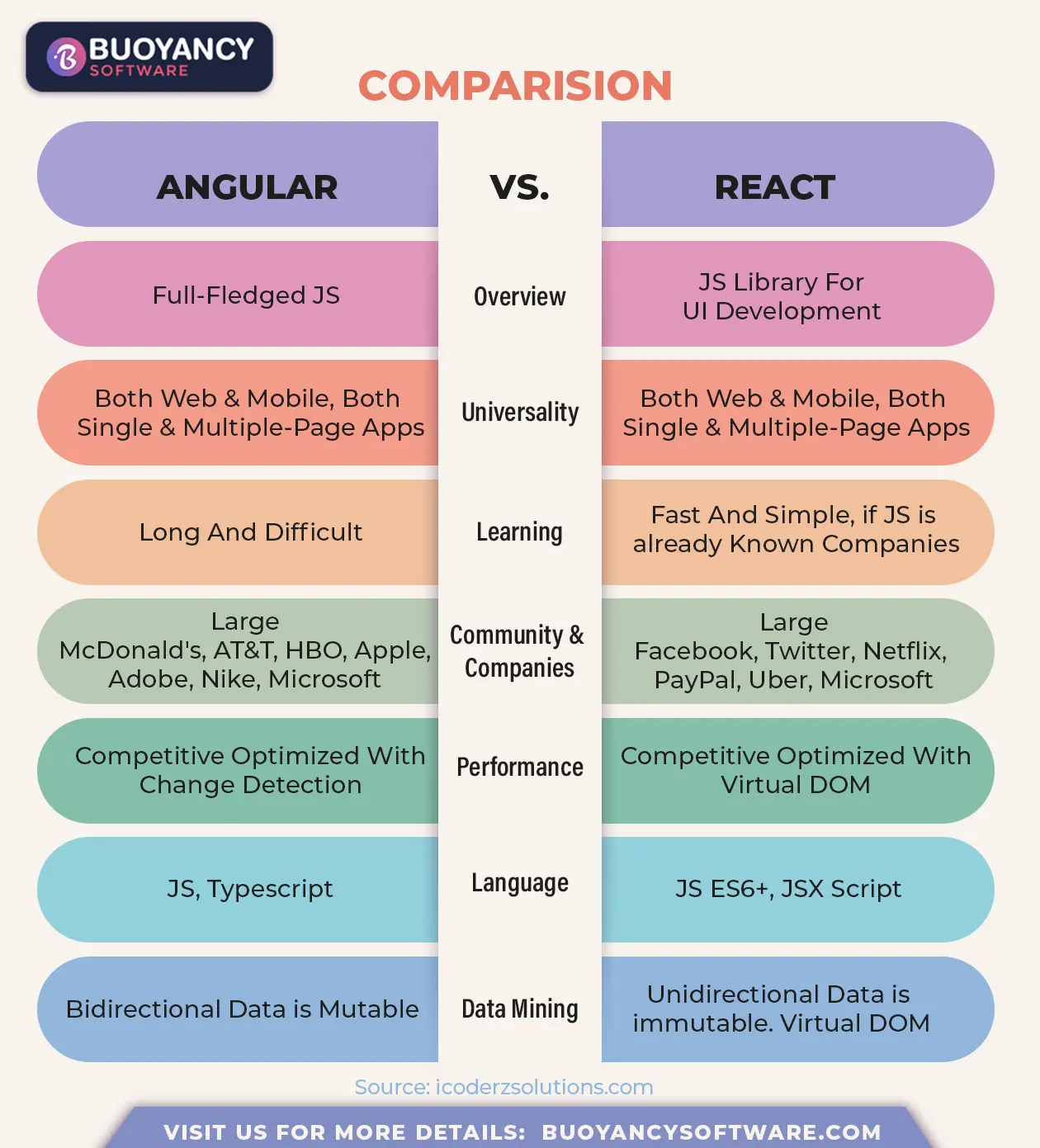
Angular is more difficult to master than React as angular has a steep learning curve. React, on the other hand, is much simpler to learn. Making an app with React is much easier for developers who are proficient in JavaScript. The Angular framework is constantly evolving, which requires developers to constantly be on the lookout for the most recent changes and upgrades to the ecosystem and evolve their skill set accordingly. As a result, react has the upper hand in this factor.
Most Used:
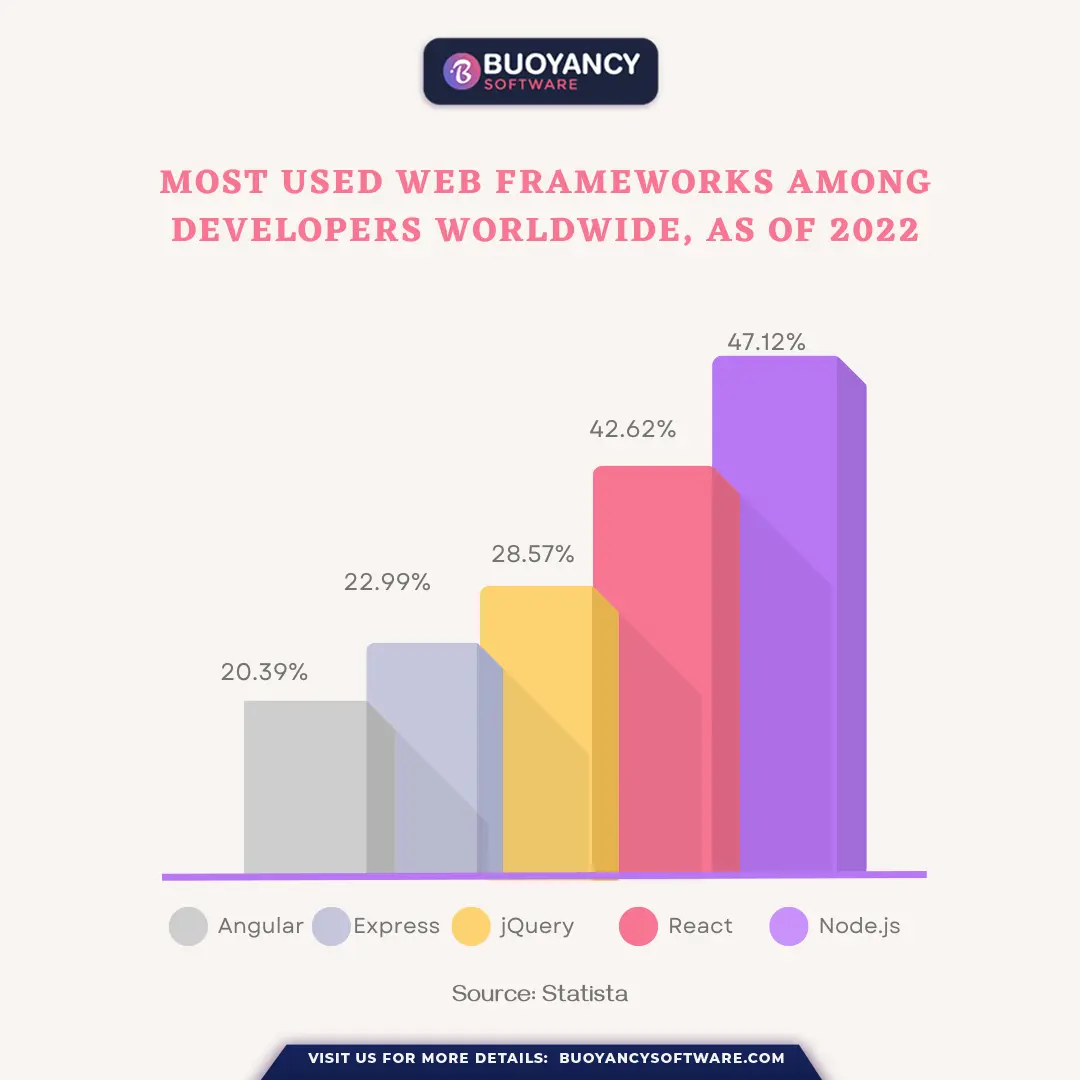
Most used web frameworks among developers worldwide, as per the Stack Overflow Developer Survey, React continues to rule the market with over 40% usage among developers while Angular holds a strong position with around 17% usage. Thus, React is popular and famous in the industry.
Architecture:
According to StackOverflow's survey, React uses JavaScript, the most popular language, while Angular uses Typescript for web development. While Typescript is believed to be much more robust and error-free, most app development companies prefer JavaScript in their process. While both Angular and React have a component-based architecture, their modular components are similarly reusable and robust. The only difference, as mentioned above, is the use of language
Data Binding:
React makes use of one-way data binding. As a result, changing the UI elements requires updating the corresponding model state. Due to the unidirectional data flow, it is common practice to stack child components inside parent components when creating a React project.
You can use two-way binding in Angular. In the model state, you can communicate changes to the associated User Interface components. Changes to the model state, on the other hand, can be better represented in the UI. This is much easier, more effective, and faster.
Use of Code:
You can manage the code in react according to the desired format. While Angular has many ready-to-use elements, they are provided by a specific provider. As a result, priority collisions and namespaces exist.
Companies Using:
React is used by companies like Facebook, Instagram, Netflix, Pinterest, etc. While Angular is used by WePay, Beam, Auto Trader, Mesh, Streamline Social, etc.
Documentation:
React's documentation is faster despite regular updates.
Angular's documentation is slower due to the ongoing development process.
Thus, while developing an enterprise-grade application, small businesses prefer React, whereas large development teams prefer Angular. Because it doesn't have much to do with organising HTML and instead focuses on the simplest ways to reuse UI components, React is a simple way to get the job done. Both frameworks are more than capable of dealing with complex projects. However, the best practice would be to base your decision on the requirements, features, and usability of your project.
Key Takeaways
Microsoft Solution Partner
ISO Certified Processes
Secure Cloud Development
Experienced Team
Global Client Experience
Frequently Asked
Questions
Get answers to the most common questions
about our products, services, and policies.
What is the main difference between React and Angular?
React is a UI library that focuses on component rendering and one-way data flow. Angular, on the other hand, is a full framework with built-in routing, forms, dependency injection, and two-way data binding. So, React gives you more flexibility while Angular gives you more structure out of the box.
Is React better than Angular for enterprise projects?
It depends on the team and the project. React is preferred for flexible front-end work and rapid prototyping. Angular is preferred for enterprise applications where a standardized architecture and built-in tooling make it easier to manage large development teams.
Which framework has a gentler learning curve, React or Angular?
React has a gentler learning curve because its core concepts are simpler and it uses plain JavaScript. Angular requires learning TypeScript along with framework-specific conventions like decorators, modules, and dependency injection, which takes more time to get comfortable with.
React vs Angular: Which JavaScript framework should you choose?
The choice between React and Angular depends on your project needs. React works best for flexible, fast-moving projects where developers want full control over their stack. Angular is a better fit for large teams building structured, enterprise-grade applications. If you need speed and simplicity, go with React. If you need built-in structure and scalability, Angular is the right choice.
React vs Angular in 2026: Which one is more relevant?
In 2026, both React and Angular are actively maintained and widely used. React continues to lead in popularity, powering apps at Meta, Netflix, and Airbnb, thanks to its large ecosystem and flexibility. Angular remains the go-to choice for enterprise teams, especially those working within the Google ecosystem. React's adoption is growing faster, but Angular's structured approach makes it easier to maintain consistency across large development teams.
The 2023 Web Evolution: A Comprehensive Guide to Modern App Architecture
React Native vs. Ionic: Strategic Selection for Cross-Platform Success