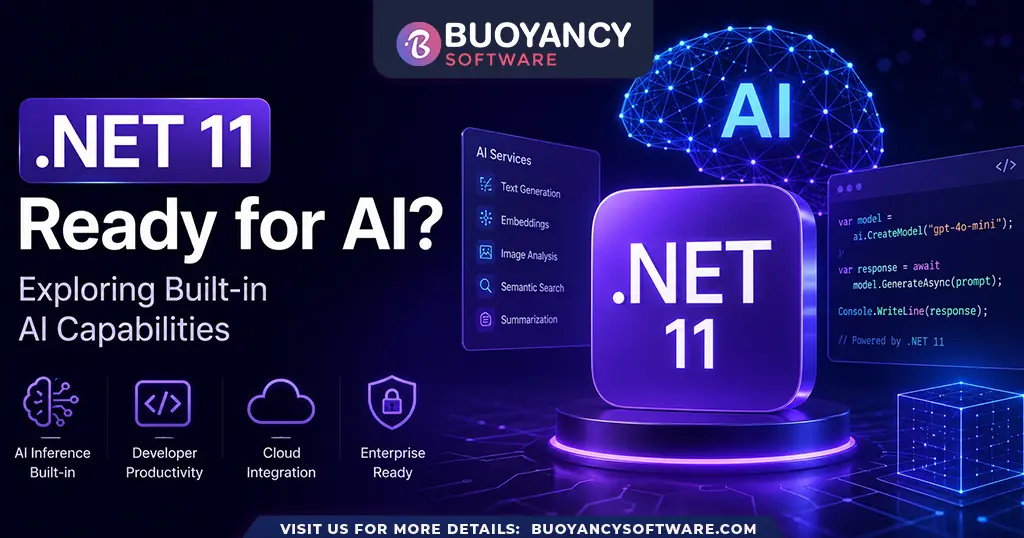
Is .NET 11 Ready for AI? Exploring Built-in AI Capabilities
This article examines whether .NET 11 is ready for AI development, covering Microsoft.Extensions.AI, tool calling, structured output, vector data support, observability, preview-stage risk, and where enterprise teams should adopt now versus wait for the stable release.
Key Takeaways
.NET 11 feels AI-ready because abstractions now fit standard .NET architecture.
Tool calling and structured output reduce fragile prompt-only integrations.
Vector support improves RAG, search, and grounded enterprise assistants.
Preview status still demands cautious production rollout and governance.
For years, building AI features in a .NET application meant stitching together vendor SDKs, custom wrappers, prompt logic, and a fair bit of hope. That is changing. The modern .NET ecosystem is no longer standing outside the AI wave, trying to catch up. It is building a proper lane for teams that want AI features without turning their codebase into an experiment.
But the important question is not whether .NET can talk to an LLM. Almost every stack can do that now. The real question is whether .NET 11 gives developers a practical, maintainable, enterprise-friendly foundation for AI applications.
As of April 29, 2026, the latest .NET 11 release is Preview 3, published on April 14, 2026. That date matters. It means we should evaluate .NET 11 honestly: not as a finished platform, but as a preview release sitting on top of an AI story that has become much stronger across the broader .NET platform.
The biggest shift is not that .NET suddenly invented AI. It is that AI development in .NET now feels like .NET development instead of a collection of disconnected hacks.
The short answer: yes, but with one important qualifier
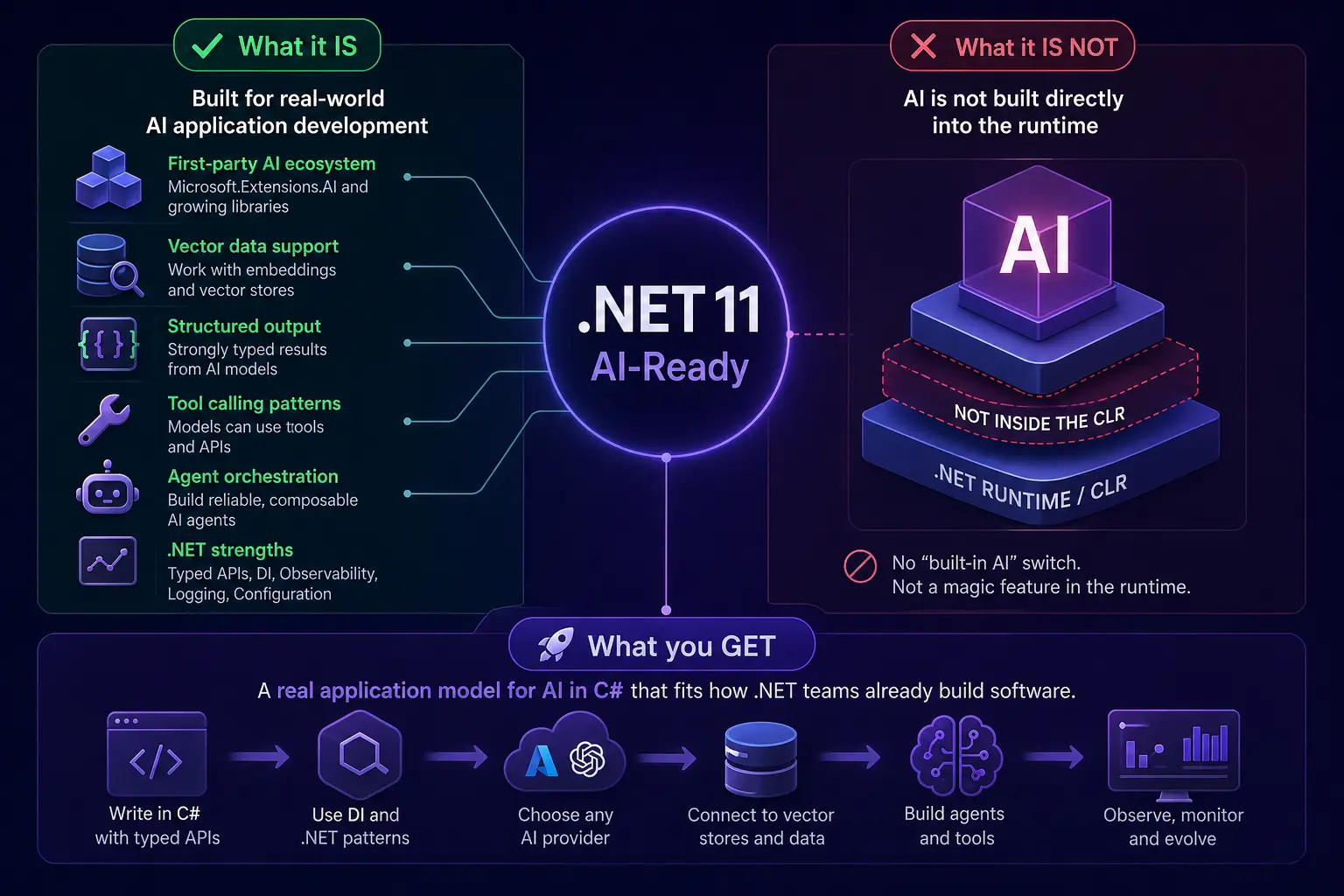
Yes, .NET 11 looks ready for serious AI development if your team values typed APIs, dependency injection, observability, and provider flexibility. No, it is not a magic switch where AI becomes built into the runtime itself. The AI readiness comes from the growing first-party ecosystem around .NET, especially Microsoft.Extensions.AI, vector data libraries, structured output support, tool calling patterns, and stronger agent orchestration options.
So if you were expecting a headline feature called built-in AI inside the CLR, that is not what is happening. What you are getting is more useful than that: a real application model for AI in C# that fits how .NET developers already build software.
What feels genuinely built in now
The strongest sign of maturity is Microsoft.Extensions.AI. It gives .NET developers a common abstraction layer for chat clients, embeddings, middleware, caching, and telemetry. That may sound technical, but it solves a very human problem inside engineering teams: nobody wants business logic tightly coupled to one model provider forever.
With this approach, teams working on web development can build around interfaces such as chat clients and embedding generators instead of hard-coding one provider's SDK into every workflow. That lowers switching costs, makes testing easier, and keeps the application architecture cleaner when product requirements inevitably change.
This is where .NET 11 becomes interesting. Even though many of these AI libraries are broader than the version number itself, .NET 11 arrives in an environment where these capabilities already fit naturally into DI, logging, configuration, and middleware patterns. That is the kind of readiness enterprise teams actually care about.
Four AI capabilities that matter most in real projects
Capability
Why it matters
Practical impact in a .NET app
Provider-agnostic AI abstractions
Reduces lock-in and keeps architecture cleaner
Swap or compare OpenAI, Azure OpenAI, Ollama, and others with less rewrite work
Tool calling
Lets models trigger application logic safely
Use C# methods and APIs as callable tools for grounded responses
Structured output
Makes AI responses easier to validate and automate
Map responses into typed models instead of parsing messy free text
Vector data support
Supports retrieval, search, and grounded generation
Build RAG and semantic search workflows with less custom plumbing
Provider-agnostic AI abstractions
CapabilityProvider-agnostic AI abstractions
Why it mattersReduces lock-in and keeps architecture cleaner
Practical impact in a .NET appSwap or compare OpenAI, Azure OpenAI, Ollama, and others with less rewrite work
Tool calling
CapabilityTool calling
Why it mattersLets models trigger application logic safely
Practical impact in a .NET appUse C# methods and APIs as callable tools for grounded responses
Structured output
CapabilityStructured output
Why it mattersMakes AI responses easier to validate and automate
Practical impact in a .NET appMap responses into typed models instead of parsing messy free text
Vector data support
CapabilityVector data support
Why it mattersSupports retrieval, search, and grounded generation
Practical impact in a .NET appBuild RAG and semantic search workflows with less custom plumbing
1. Tool calling is no longer awkward
One of the biggest reasons early AI apps felt fragile was that they depended on the model staying polite and predictable. Tool calling changes that. Instead of hoping the model describes what should happen, you can expose selected tools and let the application execute them in a controlled way. In practice, that means a .NET app can let the model request pricing data, search an internal knowledge base, or trigger a business workflow without handing over the steering wheel.
For enterprise teams, this matters more than fancy demos. Tool calling is where AI starts moving from chatbot novelty into operational usefulness.
2. Structured output makes AI less messy
A lot of AI integration pain is not about generating text. It is about using the output reliably afterward. .NET's structured output guidance pushes teams toward typed responses that fit strongly typed systems. That means sentiment labels, classification results, extraction payloads, and workflow decisions can move through a .NET application with fewer brittle parsing rules.
This sounds small until you maintain the feature six months later. Then it becomes the difference between a dependable AI component and a support headache.
3. Vector support gives .NET a better RAG story
If your AI app needs grounded answers instead of confident nonsense, vector search becomes central. The newer .NET AI documentation around vector stores, embeddings, and semantic search shows that Microsoft is treating retrieval-augmented generation as a mainstream application pattern, not a specialist side project.
That is a strong signal. It means .NET developers can build document-aware assistants, semantic search experiences, and internal knowledge tools with a more coherent stack. The vector story is still evolving, but it is no longer an afterthought.
4. Observability is finally part of the AI conversation
This is the quiet advantage that many teams miss. Good AI systems are not just about prompts and models. They are about tracing, telemetry, cost awareness, failure analysis, caching, and performance control. .NET developers already live inside that mindset. The fact that AI integrations can now plug into familiar middleware and observability patterns is a bigger deal than it first appears.
When an AI feature misbehaves in production, the question is never just, did the model answer? The question is, why did it answer that way, what external data did it use, how long did it take, and can we reproduce the issue? An experienced Azure developer can help .NET teams get much better at supporting those questions in production.
Where .NET 11 still needs caution
This is where the conversation needs discipline. .NET 11 itself is still in preview. That alone means production teams should separate platform enthusiasm from release governance. If your organization is conservative about runtime upgrades, you may choose to keep AI features on a stable .NET release while adopting the surrounding AI libraries where appropriate.
There is another nuance. Not everything in the Microsoft AI ecosystem is equally mature. Some areas are stable enough to build on confidently, while others are still moving fast. Agent frameworks, orchestration models, and newer AI abstractions are improving rapidly, but rapid improvement also means API and guidance changes are still possible.
Treat .NET 11 as preview software until general availability arrives.
Prefer abstraction layers over provider-specific shortcuts.
Design human review into high-stakes AI workflows.
Monitor latency, token usage, and failure paths from day one.
So, who should adopt it now?
If you are a product team building internal copilots, knowledge search, workflow assistants, or document intelligence features through custom application development , the answer is increasingly yes. .NET 11 and the broader .NET AI stack are already strong enough for serious prototyping, pilot deployments, and well-governed production work where preview risk is acceptable.
If you are running a heavily regulated platform, or you need strict long-term support guarantees today, the better answer may be more selective: adopt the AI architecture patterns now, but wait for the stable .NET 11 release before making it your core production runtime.
That is not hesitation. That is good engineering judgment.
Final verdict
.NET 11 is not arriving empty-handed. It is landing at a moment when .NET has a far more credible AI development model than it did even a year ago. The combination of Microsoft.Extensions.AI, structured output patterns, tool calling support, vector workflows, and stronger orchestration options makes the platform feel ready for real work.
So, is .NET 11 ready for AI? Yes, in the way that matters most to working teams. It gives developers a cleaner foundation for building AI features that are testable, observable, maintainable, and less tightly bound to one vendor. The only caveat is the obvious one: as of April 29, 2026, .NET 11 is still a preview release, so production adoption should match your risk tolerance.
If your team has been waiting for AI in .NET to feel less improvised and more architectural, this is the moment to pay attention.
If you are planning AI features on the Microsoft stack, contact our team to shape the architecture before technical debt sets in.
Get answers to the most common questions about our products, services, and policies.
Is .NET 11 officially released yet?
No. As of April 29, 2026, the latest publicly announced release is .NET 11 Preview 3, published on April 14, 2026, so teams should still treat .NET 11 as preview software.
What are the main built-in AI capabilities around .NET 11?
The main capabilities come from the wider .NET AI stack, including Microsoft.Extensions.AI abstractions, tool calling, structured output, embeddings, vector data support, telemetry, caching, and integrations with multiple AI providers.
Can .NET 11 be used for enterprise AI applications?
Yes, especially for prototypes, pilots, internal assistants, RAG solutions, and governed production scenarios. Teams just need to balance the benefits against the fact that .NET 11 is still in preview.
Does .NET 11 lock teams into Azure OpenAI only?
No. One of the strengths of Microsoft.Extensions.AI is its provider-agnostic model, which allows developers to work with Azure OpenAI, OpenAI, Ollama, GitHub Models, and other supported providers through common abstractions.
Should teams wait for the stable release before adopting AI in .NET?
Not necessarily. Many teams can adopt the architecture patterns and AI libraries now on supported .NET releases, then move to the stable .NET 11 runtime when it aligns with their support and risk requirements.