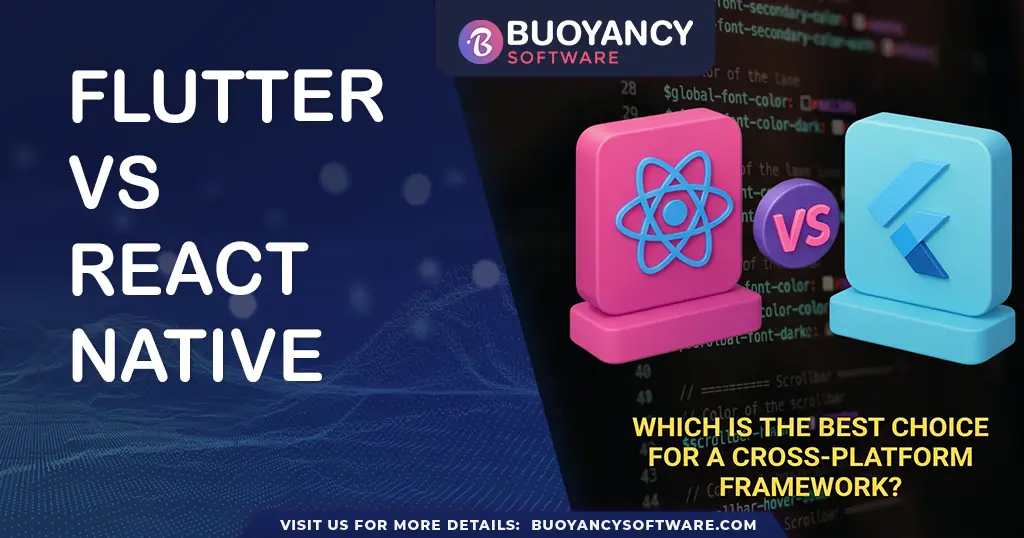
Flutter vs React Native in 2026: What the Data Says, and What We've Actually Shipped
Short answer first: if your app lives or dies on custom UI, animation, and pixel-perfect consistency across Android and iOS, choose Flutter. If your team already knows React, you need to ship fast, and you want the widest hiring pool, choose React Native. Anyone telling you one framework wins every project is selling you something — and by the numbers below, the framework gap has genuinely narrowed enough in 2026 that "which one wins" is the wrong question for most teams.
At Buoyancy Software, we build mobile products for fintech, logistics, and B2B SaaS clients who need apps shipped on a real deadline, not a research paper. We've shipped production apps in both frameworks, and we've hit the same bugs everyone else hits at 2 AM before a release. This article combines that hands-on experience with the current market data, so you're not choosing based on vibes or a framework's marketing page.
Flutter and React Native in 2026, by the Numbers
Most comparison articles skip straight to feature tables. Before that, it's worth knowing what's actually true about adoption and hiring right now, because it changes how risky each choice is.
Market share: Statista's developer survey data — the figure most widely cited across 2025–2026 industry reports — puts Flutter around 42–46% of cross-platform framework usage, with React Native around 35–38%. Stack Overflow's own developer survey shows a much tighter race (Flutter and React Native within a point or two of each other in raw usage share). The two datasets disagree because they're measuring different things: Statista's figure leans toward framework preference surveys, while Stack Overflow measures reported usage among all respondents. Treat any single "X% market share" claim you see — including ours — as directional, not gospel.
Hiring: This is the number that actually changes project risk. React Native draws from the JavaScript and React ecosystem, one of the largest developer populations in the world, and job-posting volume for React Native roles in the US consistently outpaces Flutter roles by a wide margin. If your timeline depends on scaling a team quickly or absorbing developer turnover mid-project, this matters more than any performance benchmark.
What this means practically: Flutter's popularity has grown, but React Native's talent depth is still the safer bet if you're hiring in a competitive market or building a team from scratch. Neither number should be the deciding factor on its own — they're inputs, not verdicts.
What Actually Changed in 2026
If you last evaluated these frameworks a couple of years ago, the biggest historical arguments against each one have mostly been engineered away.
Flutter: Impeller is now the default renderer everywhere. Flutter's old rendering engine (Skia) caused first-run shader compilation jank, especially on iOS. Impeller, Flutter's replacement rendering engine, is now the default on both iOS and Android, not just iOS — it precompiles shaders ahead of time, which removes that jank and keeps animations closer to a steady 60–120fps depending on device class.
React Native: the New Architecture is no longer optional. Fabric (the new renderer), TurboModules, and JSI (which replaced the old asynchronous bridge) now ship as the default architecture. This is the single biggest reason React Native's performance complaints from a few years ago don't hold up the same way today — synchronous native calls without the bridge serialization tax were the actual bottleneck, and it's gone.
The upshot: the performance conversation in 2026 is much less about "which framework is faster" and much more about which one matches your team and product. That's a genuinely different conversation than the one this topic was having in 2023.
Two of Our Own Builds
Two of our own production apps back up everything in this article. Check My Pay, a payroll and payslip app, was built in Flutter because the client wanted a heavily branded, animation-driven interface that looked identical on every device. Airobot, an IoT-powered smart home climate control app, was built in React Native because the team needed real-time device telemetry, a fast MVP timeline, and the ability to reuse logic across the app and an existing web dashboard.
Quick Comparison Table
Here's the table we actually hand to clients during a tech stack call. No vague ratings, just what we've measured on real builds plus what's changed platform-wide in 2026.
| Factor | Flutter | React Native |
|---|
| Rendering engine | Impeller (default on iOS and Android) | Fabric + JSI (New Architecture, default) |
| Performance | Near-native, consistent 60–120fps on animation-heavy screens | Native-level on most screens; needs list virtualization (e.g. FlashList) on data-heavy screens |
| Learning curve | Steeper at first — Dart and the widget tree are new for most teams | Shallow if your team already knows React |
| App size (release build) | Roughly 7–9 MB baseline for a simple app | Roughly 6–8 MB baseline, slightly smaller in our builds |
| Cost to build (MVP) | Comparable to React Native, slightly higher if Dart hiring is scarce locally | Comparable to Flutter, lower if you reuse an existing React team |
| Talent availability | Smaller pool, growing steadily | Larger pool, tied to the JavaScript/React market |
| Ecosystem maturity | Smaller but consistent; fewer abandoned packages on pub.dev | Very large but more fragmented; some npm packages go unmaintained |
FactorRendering engine
FlutterImpeller (default on iOS and Android)
React NativeFabric + JSI (New Architecture, default)
FactorPerformance
FlutterNear-native, consistent 60–120fps on animation-heavy screens
React NativeNative-level on most screens; needs list virtualization (e.g. FlashList) on data-heavy screens
FactorLearning curve
FlutterSteeper at first — Dart and the widget tree are new for most teams
React NativeShallow if your team already knows React
FactorApp size (release build)
FlutterRoughly 7–9 MB baseline for a simple app
React NativeRoughly 6–8 MB baseline, slightly smaller in our builds
FactorCost to build (MVP)
FlutterComparable to React Native, slightly higher if Dart hiring is scarce locally
React NativeComparable to Flutter, lower if you reuse an existing React team
FactorTalent availability
FlutterSmaller pool, growing steadily
React NativeLarger pool, tied to the JavaScript/React market
FactorEcosystem maturity
FlutterSmaller but consistent; fewer abandoned packages on pub.dev
React NativeVery large but more fragmented; some npm packages go unmaintained
Performance: Where the Real Difference Shows Up
Flutter compiles to native ARM code and draws every pixel itself through Impeller, so the framework isn't waiting on a JavaScript bridge to decide how a screen should look. On Check My Pay, we built a payslip detail screen with layered card animations and a custom chart. It held a steady 60fps on a mid-range Android device without us touching a single performance flag.
React Native's New Architecture closed most of the historical performance gap by replacing the old async bridge with JSI, direct native calls without the serialization overhead. On Airobot, the live device dashboard — real-time air quality readings and status updates streaming in from connected hardware — ran smoothly once we moved the list to FlashList instead of the default FlatList. Before that swap, we saw dropped frames once the number of simultaneously tracked devices and historical readings grew past a certain point.
Winner: Flutter, for animation-heavy and graphics-heavy apps. React Native is good enough for the vast majority of business apps in 2026, but data-dense screens still need deliberate list optimization to get there. If your app is mostly forms, lists, and API calls, this category barely matters anymore.
Learning Curve: Be Honest About Your Team
If your developers already write React for the web, React Native feels like an extension of skills they already have. Components, hooks, state management patterns — all of it transfers. We've onboarded React web developers onto React Native projects in under a week with almost no drop in output.
Dart itself is a clean, easy language on paper, but the real learning curve in Flutter is the widget tree mental model. New developers on our team usually need two to three weeks before they stop fighting the layout system and start moving fast. After that point, the widget composition pattern actually speeds them up, because so much of the UI is declarative and reusable.
Winner: React Native, if your team has any React background. Flutter, if you're hiring a dedicated mobile team from scratch and want them focused on one ecosystem long term.
UI and Design Control
Flutter owns its entire rendering pipeline, which means a button looks exactly the same on a Pixel and an iPhone, down to the pixel. For Check My Pay, the client's brand team had strict guidelines on color gradients, card shadows, and motion timing. Flutter let us match every spec without fighting platform defaults, because there are no platform defaults to fight.
React Native leans on native components by default, which is great when you want an app to feel platform-native, and more work when you want full design control across both platforms. On Airobot, we used NativeWind for styling and Reanimated for transitions between device states, and it got us close to Flutter-level consistency, but it took an extra design pass and a few platform-specific tweaks for iOS versus Android spacing.
Winner: Flutter, for brand-heavy or design-first apps. React Native, if you actually want the app to feel native to each platform rather than identical across both.
Development Speed
Both frameworks ship faster than building native Android and native iOS separately — that part isn't in question. The real difference is where your team's existing skill sits. On Airobot, we had a working device-pairing and live-data prototype in about two weeks, mostly because the team's React web experience carried straight over and we reused authentication and API logic from the existing web dashboard.
Flutter's hot reload is genuinely excellent and rivals or beats React Native's Fast Refresh in our day-to-day experience, especially for UI tweaks. Check My Pay's first working build with core payslip screens took around three weeks, slightly longer than Airobot's early milestone, mostly because part of the team was still getting comfortable with Dart syntax in week one.
You can see the result of that React Native build in our Airobot case study including the real-time device monitoring and energy-optimization features referenced above.
And you can explore the Flutter build itself in our Check My Pay portfolio to see the branded UI and animation work referenced above.
App Size and Resource Usage
Flutter apps tend to run slightly larger because the engine ships its own rendering layer inside the binary. Across our recent release builds, a simple Flutter app lands around 7 to 9 MB after platform-specific optimization, sometimes more once you add fonts and assets.
React Native apps are usually a bit leaner on initial size since they rely more on platform components, though the JavaScript bundle and Hermes engine add their own weight. Our React Native builds typically land closer to 6 to 8 MB for a comparable feature set.
Winner: React Native, by a small margin. In practice, a 1–2 MB difference rarely changes a user's decision to install your app, so we wouldn't let this factor decide your stack on its own.
Talent Availability and Hiring
This is the category clients underestimate most, and the one where the 2026 data is most one-sided. React Native draws from the enormous JavaScript and React talent pool, which means faster hiring, more competitive rates from candidate supply, and easier replacement if a developer leaves mid-project.
Flutter's talent pool is smaller but has grown consistently every year since Google pushed it hard for cross-platform, web, and desktop targets. Good Flutter developers are out there, but expect a longer search and possibly a higher rate in markets where Dart specialists are scarce.
Winner: React Native, clearly. If your project timeline depends on scaling a team quickly or surviving developer turnover, this matters more than most performance benchmarks — including the Impeller and New Architecture improvements above.
Ecosystem and Long-Term Maintenance
React Native's package ecosystem is massive, but massive comes with fragmentation. We've inherited React Native projects where three different navigation libraries were used across different feature branches, because each developer picked whatever was trending that month. That kind of drift creates real maintenance debt.
Flutter's package ecosystem on pub.dev is smaller but more consistent, and Google's first-party packages (like go_router and provider-adjacent state tools) tend to stay maintained longer. On Check My Pay, we haven't had to replace a single core dependency in over a year of active maintenance.
Winner: Flutter, for long-term stability. React Native, if you need a specific niche library, because the sheer size of the npm ecosystem means something probably already exists for your use case.
Companies Using Each Framework
React Native is used in production by Meta, Microsoft, Shopify, and Discord. Flutter is used by Google itself, Toyota, BMW, and eBay. Both lists prove the same point: neither framework is a toy, and both scale to apps with millions of daily users when the engineering behind them is solid.
When to Choose Flutter
- Your app needs pixel-identical UI across Android and iOS, no compromises.
- Animation and custom motion design are core to the product experience, not decoration.
- You're building a brand-first consumer app where design consistency is a competitive advantage.
- You want one codebase that can later extend to web or desktop without a rewrite.
- You're hiring a dedicated long-term mobile team rather than borrowing web developers part-time.
If your app needs custom design, smooth UI, and strong visual consistency, our hire Flutter developer page can help you build it properly, the way we built Check My Pay.
When to Choose React Native
- Your team already writes React for a web product and you want to reuse that skill.
- Speed to MVP matters more than pixel-perfect platform parity.
- You need to hire or scale a team quickly without a long search for niche talent.
- Your mobile app shares business logic, API layers, or design tokens with an existing web app.
- You're building a practical business, SaaS, or IoT-connected app where native platform feel matters more than a unified custom look.
Airobot is the clearest example of this from our own work. The client needed a device-connected mobile app live fast, with real-time data logic that mirrored an existing web dashboard almost exactly. React Native let a React-leaning team ship a working app without spending their first month learning a new language.
If your team wants to build mobile apps with React skills and faster onboarding, explore our hire React Native developer page.
Final Verdict
There's no universal winner here, and treating this as a popularity contest wastes your time. Flutter wins when design control and animation quality are non-negotiable. React Native wins when your team's existing React skill and hiring speed matter more than pixel-perfect rendering. The 2026 platform updates — Impeller everywhere, the New Architecture by default — mean both frameworks now perform well enough that this decision comes down to your team and your product, not a capability gap.
If you're still unsure, ask one question: does a user notice or care that your app looks slightly different on Android versus iOS? If yes, lean Flutter. If your users only care that the app works fast and reliably, lean React Native. Budget, team composition, and timeline should settle any remaining tie.
Not sure which way your project leans? Our team has shipped production apps in both frameworks for fintech, logistics, and IoT clients, and we can usually tell you which one fits your project in a single call, not a sales pitch. Book a free technical consultation and we'll walk through your requirements, team, and timeline together.
Key Takeaways
Microsoft Solution Partner
ISO Certified Processes
Secure Cloud Development
Experienced Team
Global Client Experience
Frequently Asked
Questions
Get answers to the most common questions
about our products, services, and policies.
What is the main difference between Flutter and React Native?
Flutter uses Dart and renders its own UI from scratch through its Impeller engine, which gives near-identical visuals on Android and iOS. React Native uses JavaScript or TypeScript and renders through native platform components via its New Architecture (Fabric), which gives a more platform-native feel but slightly less cross-platform visual consistency.
Which is better for mobile app development, Flutter or React Native, in 2026?
Neither is universally better. Flutter is the stronger choice for design-heavy, animation-heavy apps that need pixel parity across platforms. React Native is the stronger choice when your team already knows React, you need to move fast, or you're sharing code with an existing web product.
Is Flutter faster than React Native in 2026?
The performance gap has narrowed significantly since both frameworks shipped major architecture updates: Flutter's Impeller renderer (now default on iOS and Android) and React Native's New Architecture (Fabric, TurboModules, JSI, also now default). In our builds, Flutter still holds a slight edge on animation-heavy screens because it controls rendering directly. React Native performs just as well for typical business apps once data-heavy screens are optimized with tools like FlashList.
Is React Native easier to learn than Flutter?
Yes, if your developers already know React. They typically need under a week to get productive in React Native. Flutter developers usually need two to three weeks to get comfortable with the widget tree model, even though Dart itself is straightforward to pick up.
Which framework is better for startups, Flutter or React Native?
Most startups benefit from React Native because it lets a small team move fast and hire easily if they need to scale, and it draws from a much larger talent pool. Startups building a design-first or animation-heavy consumer product, where visual polish is the main differentiator, often get more value from Flutter.
What is Flutter's market share compared to React Native in 2026?
Estimates vary by source. Statista's developer survey data, the most widely cited figure across 2025–2026 industry reports, puts Flutter around 42–46% of cross-platform framework usage versus React Native's 35–38%. Stack Overflow's own developer survey shows a much narrower gap. React Native still holds a clear lead in job-posting volume, since it draws from the broader JavaScript ecosystem.
Can I build production apps with Flutter and React Native?
Yes, both are proven in production at scale. Meta, Shopify, and Discord run on React Native. Google, Toyota, and BMW run apps on Flutter. The framework matters less than the architecture decisions and the experience of the team building on top of it.
What Is Microsoft Fabric and Why It’s the Future of AI-Powered Analytics
Is .NET 11 Ready for AI? Exploring Built-in AI Capabilities