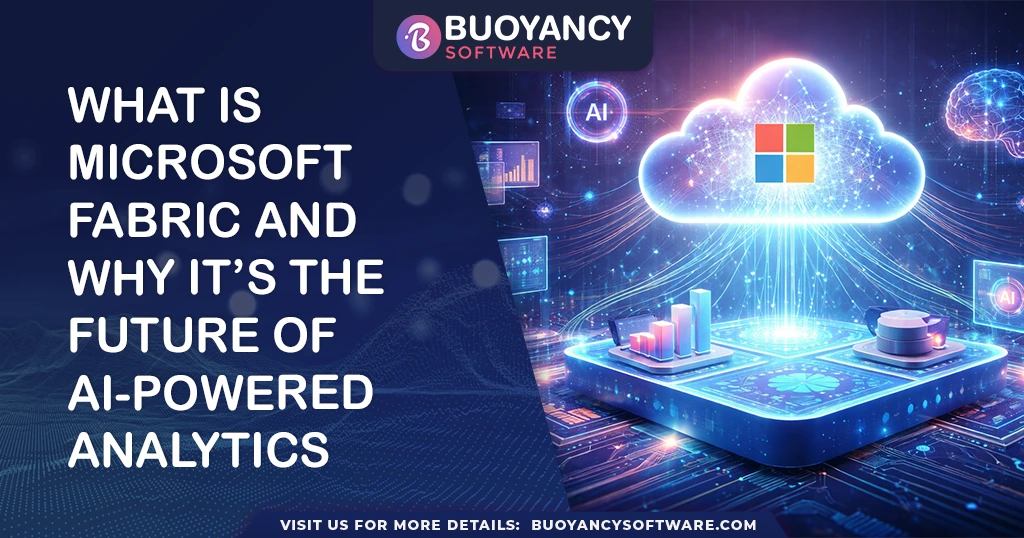
What Is Microsoft Fabric and Why It’s the Future of AI-Powered Analytics
There is a familiar problem most growing businesses face. Data exists everywhere — in CRMs, ERPs, spreadsheets, cloud apps, and internal systems. But when it comes time to make decisions, that data rarely speaks in one voice.
Teams spend more time collecting and cleaning data than actually analysing it. Reports are delayed. Insights are fragmented. And by the time leadership gets a clear picture, the moment to act has already passed.
This is exactly the problem Microsoft Fabric is designed to solve. It is not just another analytics tool. It is a complete rethinking of how modern data platforms should work in an AI-first world. Businesses investing in machine learning services are already seeing how unified platforms like Fabric accelerate the path from raw data to real decisions.
What Is Microsoft Fabric?
Microsoft Fabric is an end-to-end, unified data platform that brings together data engineering, data integration, data science, real-time analytics, and business intelligence into a single ecosystem.
Traditionally, organisations had to stitch together multiple tools — one for data pipelines, another for warehousing, another for dashboards, and yet another for AI models. Each tool came with its own setup, pricing, and complexity.
Microsoft Fabric removes this fragmentation. It provides everything in one place, built on a shared data foundation called OneLake. This means your data is stored once but can be used across multiple services without duplication.
Microsoft Fabric is not just a toolset. It is a unified experience where data, analytics, and AI work together seamlessly.
Why Traditional Analytics Platforms Fall Short
To understand the value of Microsoft Fabric, it helps to look at what businesses struggle with today.
Most analytics setups are built in silos. Data engineers use one platform, analysts use another, and business users rely on separate reporting tools. Moving data between these layers introduces delays, errors, and unnecessary costs.
On top of that, scaling AI capabilities becomes difficult. Data scientists often spend weeks preparing datasets instead of building models. Real-time insights are hard to achieve because systems are not designed to work together.
The result is a system that is technically functional but operationally slow.
Key Components of Microsoft Fabric
Microsoft Fabric brings multiple capabilities under one umbrella. Each component is powerful on its own, but the real value comes from how they integrate.
OneLake – The Foundation
OneLake acts as a central data lake for the entire organisation. Instead of maintaining multiple copies of data across systems, everything is stored once and accessed securely by different teams.
This reduces redundancy, lowers storage costs, and ensures everyone is working with the same version of truth.
Data Engineering and Integration
With built-in data pipelines and transformation tools, teams can ingest data from various sources and prepare it for analysis without switching platforms.
This significantly reduces the time required to move from raw data to usable insights.
Data Science and AI
Microsoft Fabric integrates data science capabilities directly into the platform. Teams can build, train, and deploy machine learning models using the same data they are already analysing.
For businesses building this capability in-house, it often makes sense to hire data scientists who can turn unified enterprise data into production-ready models and measurable outcomes.
This tight integration removes the traditional gap between analytics and AI, making it easier to operationalise intelligent insights.
Real-Time Analytics
Businesses no longer need to wait for batch processing. Microsoft Fabric supports real-time data streaming and analytics, allowing organisations to respond instantly to changes.
This is especially valuable in industries like logistics, finance, and e-commerce, where timing directly impacts outcomes.
Business Intelligence with Power BI
Microsoft Fabric is deeply integrated with Power BI, enabling users to create dashboards and reports directly from the unified data layer. To get the most out of this integration, many organisations choose to hire Power BI developers who can design and deliver meaningful, decision-ready reports.
This ensures that insights are not just generated but also easily consumed by decision-makers across the organisation.
Why Microsoft Fabric Is the Future of AI-Powered Analytics
The shift towards AI-driven decision-making is not optional anymore. Businesses that fail to adopt it risk falling behind competitors who can act faster and smarter.
Microsoft Fabric is built with this future in mind. It simplifies the entire data journey, making AI more accessible and practical for real-world use.
Unified Data Eliminates Complexity
By removing data silos, Microsoft Fabric ensures that all teams work from a single source of truth. This improves data quality and trust, which are critical for AI models to deliver accurate results.
Faster Time to Insight
Since data does not need to move between multiple systems, insights can be generated much faster. This allows businesses to make decisions in near real-time.
That speed becomes even more valuable when paired with predictive analytics services , helping teams move from reporting what happened to anticipating what happens next.
Built for Scalability
Microsoft Fabric is designed to scale with the organisation. Whether you are handling gigabytes or petabytes of data, the platform adapts without requiring major architectural changes.
Seamless AI Integration
Unlike traditional platforms where AI feels like an add-on, Microsoft Fabric treats it as a core capability. This makes it easier to embed intelligence into everyday business processes.
The future of analytics is not just about understanding data. It is about acting on it instantly with the help of AI.
Real-World Use Cases
Microsoft Fabric is already being adopted across industries where data plays a critical role in operations.
In logistics and supply chain, companies use it to track shipments in real time and predict delays. In retail, it helps analyse customer behaviour and optimise inventory. In finance, it enables fraud detection and risk analysis using AI models.
The common thread across these use cases is speed and accuracy. Businesses are not just collecting data — they are using it to act faster.
Who Should Consider Microsoft Fabric?
Microsoft Fabric is particularly valuable for organisations that deal with large volumes of data and need quick, reliable insights.
If your business relies on multiple data sources, struggles with reporting delays, or is planning to implement AI-driven solutions, Microsoft Fabric is worth serious consideration.
It is especially relevant for enterprises already using the Microsoft ecosystem, as integration becomes even smoother.
Final Thoughts
The way businesses handle data is changing rapidly. The old model of disconnected tools and delayed insights is no longer sustainable in a world driven by AI.
Microsoft Fabric represents a shift towards simplicity, speed, and intelligence. By unifying data, analytics, and AI into a single platform, it removes the friction that has traditionally slowed down decision-making.
For organisations looking to stay competitive, the question is no longer whether to adopt AI-powered analytics — it is how quickly they can implement it effectively. Microsoft Fabric provides a clear path forward.
Talk to Our Team
If you are evaluating Microsoft Fabric for analytics, reporting, or AI initiatives and want a practical implementation roadmap, Contact Buoyancy Software to discuss your goals with our team.
Key Takeaways
Microsoft Solution Partner
ISO Certified Processes
Secure Cloud Development
Experienced Team
Global Client Experience
Frequently Asked
Questions
Get answers to the most common questions
about our products, services, and policies.
What is Microsoft Fabric?
Microsoft Fabric is a unified, end-to-end data platform that combines data engineering, data integration, data science, real-time analytics, and Power BI into a single ecosystem built on a shared data foundation called OneLake.
How is Microsoft Fabric different from traditional analytics platforms?
Unlike traditional platforms that require separate tools for pipelines, warehousing, dashboards, and AI models, Microsoft Fabric consolidates everything into one place, reducing complexity, cost, and the overhead of moving data between systems.
What is OneLake in Microsoft Fabric?
OneLake is the central data lake built into Microsoft Fabric that stores all organisational data in one place. Different services and teams access the same data without duplication, ensuring consistency and reducing storage costs.
Which industries benefit most from Microsoft Fabric?
Microsoft Fabric is especially valuable for logistics, finance, retail, and e-commerce industries where real-time data access and AI-driven decisions directly impact business outcomes such as shipment tracking, fraud detection, and inventory optimisation.
Is Microsoft Fabric suitable for organisations already using Microsoft tools?
Yes, Microsoft Fabric integrates seamlessly with existing Microsoft tools including Azure, Power BI, and Microsoft 365, making adoption significantly smoother and more cost-effective for organisations already in the Microsoft ecosystem.
Why Enterprise Teams Choose ABP.IO for Web App Development (And Why It Changes Everything)
Flutter vs React Native in 2026: Data & Real-World Experience