October 07, 2026
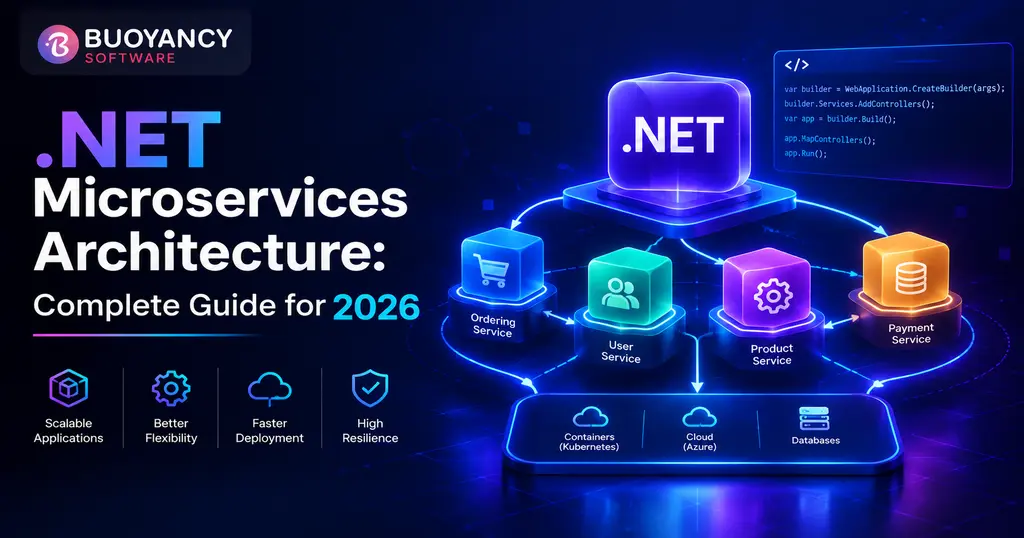
.NET Microservices Architecture: Complete Guide for 2026
Should you build .NET microservices or a modular monolith? Covers ASP.NET Core, .NET Aspire, AKS, OpenTelemetry, and best practices for enterprise teams.


We have successfully completed projects with dedication to the highest levels of customer satisfaction.

Paycheck analysis service to ensure accurate compensation.

Web logistics solution for streamlined shipping and tracking.

Web platform for marketplace management and business insights.

Web solution for legal professionals with powerful case management.

Web software for handling and optimizing business operations.

An IoT-powered smart home app for efficient climate and air quality automation.

Interactive city discovery experience for events and places.

SaaS platform that turns inventory spreadsheets into online resale storefronts.
Inspire trust and foster an ethical culture to thrive.
 Excellence
 Transparency & Integrity
 Innovation
 Collaboration
 Accountability


We partners with businesses to simplify technology, unlock innovation, and build secure, scalable solutions that support long-term success.

Should you build .NET microservices or a modular monolith? Covers ASP.NET Core, .NET Aspire, AKS, OpenTelemetry, and best practices for enterprise teams.



Ask ten .NET architects whether to build microservices in 2026 and you'll get ten different answers, and honestly, most of them will be right for their specific situation. That's the part most guides skip. They'll walk you through API gateways and service discovery like the decision to go distributed was already made for you. It wasn't.
This guide covers what a .NET microservices architecture actually looks like in 2026, where .NET Aspire fits and where it doesn't, how ASP.NET Core services talk to each other, and where teams consistently get it wrong. We'll also get into the question a lot of 2025-era content ignores: whether you need microservices at all, or whether a modular monolith gets you there with a fraction of the operational cost.
A microservices architecture splits an application into independently deployable services, each owning its own data and business logic, communicating over the network instead of through in-process method calls. In .NET, that usually means a set of ASP.NET Core Web APIs, each built, tested, and deployed on its own schedule, rather than one large solution where every team waits on the same release train.
The appeal is real: teams can scale the checkout service without scaling the entire platform, deploy a fix to inventory without touching billing, and use the right tool for each job. The cost is real too, and it's the part sales decks tend to gloss over. You're trading a single process's simplicity for distributed systems problems: network latency, partial failures, eventual consistency, and a debugging session that now spans five services instead of one.
This is the debate that's actually happening in .NET architecture circles right now, and it's worth taking seriously instead of assuming microservices are the default correct answer. A modular monolith keeps the codebase in one deployable unit but enforces the same strict boundaries between modules that microservices enforce between services. You get most of the maintainability benefit without the network hop, the distributed transaction headaches, or twenty separate CI/CD pipelines to maintain.
| Factor | Microservices | Modular Monolith |
|---|---|---|
| Team size needed to justify it | Multiple independent teams, each owning a service | Works well for a single team or a few small ones |
| Deployment | Independent per service | One deployable unit, simpler pipeline |
| Performance | Network calls between services add latency | In-process calls, no network overhead |
| Operational complexity | Higher: service discovery, distributed tracing, multiple databases | Lower: one process, one database, simpler observability |
| Best fit | Large orgs, independently scaling workloads | Startups, mid-size teams, unclear domain boundaries |
If you're not sure which camp you're in, that's actually useful information. Teams with well-understood domain boundaries and multiple teams stepping on each other's deployments tend to benefit from splitting. Teams still figuring out where the boundaries even are usually do better starting with a modular monolith and splitting out services later, once a boundary has proven itself stable under real usage.
Whichever direction you go, a handful of pieces show up in nearly every production-grade .NET microservices system.
| Building Block | What It Does |
|---|---|
| API Gateway | Single entry point that routes requests, handles auth, and shields clients from internal service topology |
| Service discovery | Lets services find each other's current network location as instances scale up and down |
| Database per service | Each service owns its data store, preventing hidden coupling through a shared schema |
| Message broker | Enables asynchronous, event-driven communication between services that don't need an immediate response |
| Distributed tracing | Follows a single request across multiple services to make failures debuggable |
| Circuit breaker | Stops a failing downstream service from cascading failures across the whole system |
The communication pattern you pick for each interaction matters more than picking one pattern for the whole system. Most real .NET microservices architectures use a mix.
| Pattern | When to Use It |
|---|---|
| REST over HTTP | External-facing APIs and simple request-response calls between services |
| gRPC | High-throughput internal service-to-service calls where performance and strict contracts matter |
| Async messaging (queues/events) | Operations that don't need an immediate response, like sending a confirmation email after an order |
A common mistake is picking REST for everything because it's familiar, then wondering why a checkout flow times out waiting on four synchronous calls to services that could have run in parallel or fired asynchronously instead. gRPC's binary protocol and strict contracts genuinely help at scale, but it adds tooling overhead that isn't worth it for a handful of low-traffic internal calls.
.NET Aspire has matured a lot since its 2023 introduction. As of Aspire 13, it handles multi-language orchestration, not just .NET, and its Service Defaults library wires up logging, tracing, health checks, and retry policies consistently across every service in a solution, instead of each team configuring OpenTelemetry by hand and getting slightly different results.
Worth being precise about what it isn't, though. Aspire doesn't replace Kubernetes or Azure Container Apps, and it isn't required to build .NET microservices at all. It's a local development and orchestration layer that generates deployment manifests for whatever platform you actually deploy to. If your team already has solid Docker Compose or Kubernetes tooling, Aspire may add a layer you don't need. If you're starting fresh and tired of the works-on-my-machine tax that comes with wiring up five services by hand, it's worth a serious look.
For a deeper, code-level walkthrough of Aspire alongside Microsoft's Agent Framework and MCP, see our guide on building a real-world AI agent with Microsoft Agent Framework, Foundry, MCP, and Aspire .
Every .NET microservice ends up in a container eventually, but where that container runs is a real decision, not a formality.
| Platform | Best For |
|---|---|
| Docker | Local development and building the container images themselves |
| Azure Kubernetes Service (AKS) | Complex systems needing fine-grained control over networking, scaling policies, and multi-cluster setups |
| Azure Container Apps | Teams that want Kubernetes-style scaling without managing a cluster directly |
Azure Kubernetes Service gives you full control and the steepest learning curve. Azure Container Apps trades some of that control for a much shorter path to production, which is exactly why plenty of small and mid-size .NET teams start there instead of committing to a full Kubernetes cluster on day one.
In a monolith, a stack trace tells you almost everything. In a microservices architecture, a single user request might touch six services, and figuring out which one actually failed without proper tracing is close to impossible. OpenTelemetry has become the standard here precisely because it's vendor-neutral: the same instrumentation works whether you're sending data to Azure Monitor, Grafana, or something else entirely.
Teams that add observability after their third unexplainable production incident always say the same thing: they wish they'd wired it in from service one. It's genuinely easier to build tracing into a service from the start than to retrofit it once five services are already talking to each other in ways nobody fully documented.
The most expensive mistake is splitting a system before the team understands its own domain boundaries well enough to split it correctly. Services drawn along the wrong lines end up needing constant synchronous calls to each other just to complete basic operations, which is worse than a monolith: you get all the network overhead with none of the independence. A close second is treating distributed transactions casually. Two-phase commits across services rarely work well in practice; patterns like the Saga pattern, which coordinate a sequence of local transactions with compensating actions, tend to hold up much better under real failure conditions.
A small, well-scoped microservices system, four to six services with a gateway and basic CI/CD, typically runs a few months for an experienced team. Enterprise-scale systems with a dozen or more services, full observability, and multi-region deployment are a longer engagement, often six months to a year depending on how much of the domain is already well understood going in. The biggest cost driver isn't the number of services. It's how much time gets spent redrawing service boundaries after the first version turns out to be wrong.
Buoyancy Software is a Microsoft Solutions Partner and ISO 27001 certified custom software and IT consulting company, with delivery teams in Ahmedabad, India and Edison, New Jersey. Our .NET developers apply this same bounded-context-first approach when we design microservices architectures for clients, rather than splitting a system before its domain boundaries are actually understood.
That uncertainty is normal, and it's worth resolving before writing the first service, not after the third one turns out to be drawn along the wrong lines. Buoyancy Software's custom application development team has designed both microservices and modular monolith systems in .NET, and we can help you figure out honestly which one your team and your domain actually call for.
Book a free consultation and get a straight answer on your architecture, not a sales pitch for the most complex option.
Get answers to the most common questions
about our products, services, and policies.