Why Choose a Microsoft Solutions Partner Instead of a General IT Company?
This guide compares Microsoft Solutions Partners against general IT companies, helping businesses choose the right vendor based on verification, certified expertise, security compliance, and cost.
Key Takeaways
Microsoft Solutions Partners are independently verified by Microsoft for technical expertise, performance, and customer success.
They replaced the Gold and Silver Partner programs in 2022 and must renew their designation annually.
Unlike general IT companies, they offer Microsoft-validated expertise and access to exclusive resources.
Always verify a partner's status through Microsoft's official Partner directory.
Why Choose a Microsoft Solutions Partner Instead of a General IT Company?
Not every IT vendor who says they "work with Microsoft" can back that claim with anything Microsoft itself has verified. That distinction matters more than most buyers realize, and it is the whole reason the Microsoft Solutions Partner designation exists.
If you are comparing a certified Microsoft Solutions Partner against a general IT company for your next project, whether that is a cloud migration, a Dynamics 365 implementation or a full digital transformation initiative, this guide breaks down exactly what separates the two, what the designation actually verifies, and how to tell whether a vendor's claim holds up.
What Is a Microsoft Solutions Partner, Exactly?
The term gets used loosely, so it is worth being precise. Microsoft retired the old Gold and Silver Partner competency system on September 30, 2022, and replaced it with the Solutions Partner framework under what is now called the Microsoft AI Cloud Partner Program. Any company still advertising "Gold Partner" status today either has not updated its credentials or is referencing something that no longer exists.
To earn a Solutions Partner designation, a company has to clear a capability score of at least 70 out of 100, calculated from three inputs: performance (actual usage and billed consumption of Microsoft cloud products), skilling (the number of relevant certifications held by staff), and customer success (verified case studies and satisfaction data submitted through Microsoft's own systems). This score is not a one-time badge. It gets re-evaluated annually, so a partner has to keep earning it.
The Six Solutions Partner Designations
Microsoft does not hand out one generic badge. Designations are split into six solution areas, and a company can hold one, several, or all six depending on where its verified expertise lies.
Designation
Covers
Data & AI (Azure)
Analytics, Microsoft Fabric, Azure AI, machine learning
Modern Work
Microsoft 365, Microsoft Teams, Copilot for Microsoft 365, SharePoint
CoversMicrosoft Defender, Microsoft Entra ID, Microsoft Purview
Digital & App Innovation (Azure)
DesignationDigital & App Innovation (Azure)
CoversAzure DevOps, containers, custom application development
Fewer than a small fraction of Microsoft partners globally hold more than two or three of these designations at once, since each one requires its own certification investment and its own verified customer track record. When you see a company reference a specific designation rather than a generic "Microsoft Partner" claim, that specificity is a good sign. It means they can point to exactly what Microsoft has verified, not just that a relationship exists.
What Is a General IT Company, and Where Does It Fit?
A general IT company is not a lesser choice by default. Plenty of general IT vendors do solid work, especially for smaller, low-complexity projects like basic website maintenance, help desk support, or straightforward hardware procurement. The distinction is not about skill, it is about verification. A general IT company can claim Microsoft expertise on its website with no independent party checking whether that claim is accurate. There is no capability score, no annual re-assessment, and no Microsoft-verified customer success data behind the claim.
That gap matters more as the stakes go up. If you are migrating a production database to Azure, rolling out Microsoft 365 Copilot across a regulated business, or implementing Dynamics 365 as your system of record, you are trusting the vendor's own word for their qualifications. With a Solutions Partner, you are trusting Microsoft's audit of that vendor instead.
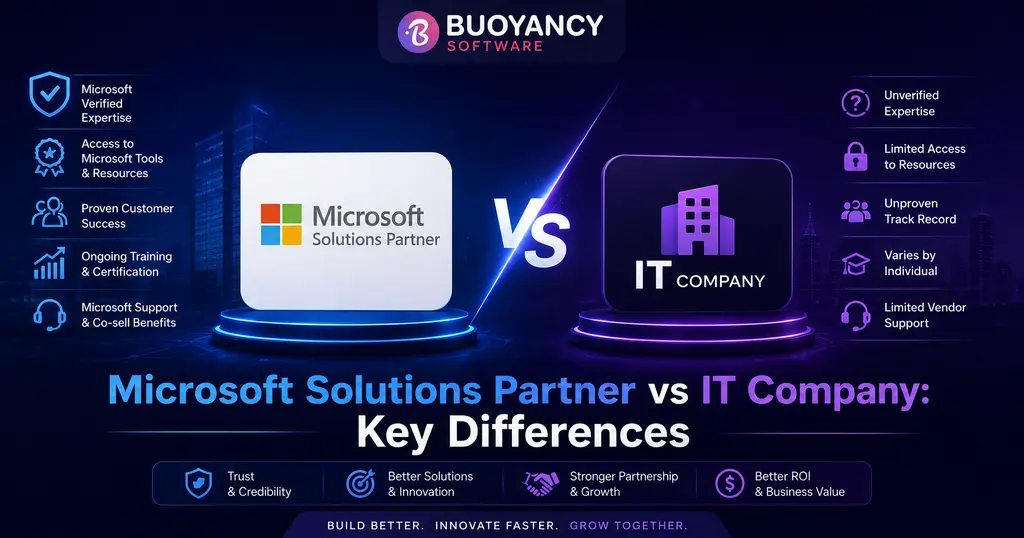
Microsoft Solutions Partner vs. General IT Company: Head-to-Head
Factor
Microsoft Solutions Partner
General IT Company
Verification
Independently scored by Microsoft annually
Self-reported, no third-party audit
Certified staff
Minimum certification thresholds enforced
Varies, not independently confirmed
Access to Microsoft resources
Direct access to Microsoft engineering and early-release tools
Microsoft Solutions PartnerIndependently scored by Microsoft annually
General IT CompanySelf-reported, no third-party audit
Certified staff
FactorCertified staff
Microsoft Solutions PartnerMinimum certification thresholds enforced
General IT CompanyVaries, not independently confirmed
Access to Microsoft resources
FactorAccess to Microsoft resources
Microsoft Solutions PartnerDirect access to Microsoft engineering and early-release tools
General IT CompanyPublic documentation only
Customer success proof
FactorCustomer success proof
Microsoft Solutions PartnerVerified case studies submitted to Microsoft
General IT CompanyTestimonials, unverified
Specialization visibility
FactorSpecialization visibility
Microsoft Solutions PartnerNamed designation (e.g. Security, Data & AI)
General IT CompanyGeneric "IT services" positioning
Renewal requirement
FactorRenewal requirement
Microsoft Solutions PartnerRe-qualified every year
General IT CompanyNo renewal or ongoing standard
Best suited for
FactorBest suited for
Microsoft Solutions PartnerCloud migrations, Azure/M365/Dynamics 365 projects, regulated workloads
General IT CompanyBasic support, hardware, low-complexity IT tasks
Why the Verification Gap Actually Matters for Your Business
It is tempting to treat "Microsoft partner" as a soft marketing phrase, but the practical differences show up fast once a project is underway. A verified Solutions Partner has demonstrated, through actual billed usage and certification records, that its team can operate inside Azure, Microsoft 365, or Dynamics 365 at a level Microsoft itself is willing to stake its name on. That translates into fewer configuration mistakes, faster troubleshooting when something breaks, and access to Microsoft engineering escalation paths that a general IT company simply does not have.
There is also a compliance angle that is easy to overlook. Businesses in regulated industries, healthcare, finance, and government contracting among them, increasingly need to document their vendor's qualifications as part of their own audit trail. "We hired a company that said they knew Azure" is a weak answer during a compliance review. "We hired a Microsoft-verified Security designation partner" is not.
How to Verify a Partner's Claim Before You Sign Anything
Do not take a badge on a website at face value; Microsoft makes verification simple, and it takes about two minutes.
Search the company by name in Microsoft's official Partner Center directory to confirm active designations.
Check which specific designation they hold. "Microsoft Partner" alone means nothing; "Solutions Partner for Business Applications" means something specific and verifiable.
Ask when the designation was last renewed. Since these expire annually, a designation earned three years ago and never mentioned again is a signal to ask more questions.
Ask for the Microsoft-verified case studies behind their customer success score, not just testimonials from their own website.
When a General IT Company Is Actually the Right Call
In fairness, a Solutions Partner is not the answer to every IT need. If your requirement is basic hardware support, a help desk contract, or general network maintenance with no deep Microsoft platform dependency, a competent local IT company can often do the job faster and at a lower cost, without the overhead of Microsoft's certification requirements. The decision point is really about how deeply your project depends on Azure, Microsoft 365, Dynamics 365, or the Power Platform. The deeper that dependency, the more the verification gap actually costs you if it goes unaddressed.
The Cost Question: Is a Solutions Partner More Expensive?
Not necessarily, and this is where a lot of buyers make the wrong assumption. Solutions Partners often have access to Microsoft co-selling incentives, migration funding programs, and licensing guidance that can offset or even lower your total project cost compared to a general IT vendor working without that visibility. A vendor with no direct relationship to Microsoft's partner incentive programs is also a vendor with no ability to pass those savings on to you. The certification itself is not what costs more. What costs more is finding out mid-project that your vendor's Azure expertise was never verified by anyone but themselves.
Why This Guide
Buoyancy Software is a Microsoft Solutions Partner and an ISO 9001 and ISO 27001 certified custom software and IT consulting company, with delivery teams in India and USA. This guide reflects the same evaluation criteria we recommend clients apply to any vendor working across Azure, Microsoft 365, or Dynamics 365.
Not Sure If Your Current Vendor's Microsoft Claims Hold Up?
Choosing between a Microsoft Solutions Partner and a general IT company is not just a branding question, it is a risk decision that affects how smoothly your Azure, Microsoft 365, or Dynamics 365 project actually goes. Buoyancy Software holds a verified Microsoft Solutions Partner designation and has helped businesses across the US and beyond plan, migrate, and scale on Microsoft's platform with a team Microsoft has independently vetted, not just one that says it can.
Book a free consultation with our Microsoft Solutions Partner team and get an honest assessment of where your current setup stands.
Get answers to the most common questions about our products, services, and policies.
What is the difference between a Microsoft Solutions Partner and a Microsoft Partner?
"Microsoft Partner" is a general umbrella term that simply means a company is enrolled in the Microsoft AI Cloud Partner Program. "Solutions Partner" is a specific, earned designation within that program, verified against a capability score. Every Solutions Partner is a Microsoft Partner, but not every company calling itself a Microsoft Partner has earned a Solutions Partner designation.
Is a Microsoft Solutions Partner better than a regular IT company?
Not automatically better at every task, but more verifiable for Microsoft platform work specifically. A general IT company may have equally skilled staff, but there is no independent audit behind that claim the way there is with a Solutions Partner's annual capability score.
How do I verify if a company is really a Microsoft Solutions Partner?
Search the company's name directly in Microsoft's official Partner Center directory. This shows their active designations in real time, rather than relying on a badge displayed on the company's own website, which can be outdated or unverified.
What are the six Microsoft Solutions Partner designations?
The six core designations are Data & AI (Azure), Modern Work, Business Applications, Infrastructure (Azure), Security, and Digital & App Innovation (Azure). A company can hold one or several, depending on where its verified expertise lies.
Does Microsoft Gold Partner status still exist in 2026?
No. Microsoft retired the Gold and Silver Partner competency tiers on September 30, 2022, and replaced them with the Solutions Partner designation framework. Any company still marketing itself as a Gold Partner has not updated its credentials to the current system.
Is working with a Microsoft Solutions Partner more expensive than a general IT company?
Not necessarily. Solutions Partners often have access to Microsoft co-selling incentives and migration funding that can offset project costs, something a general IT company without that partner relationship cannot offer.